


THC Tolerance 101: How to Reset Your System and Find Your Sweet Spot
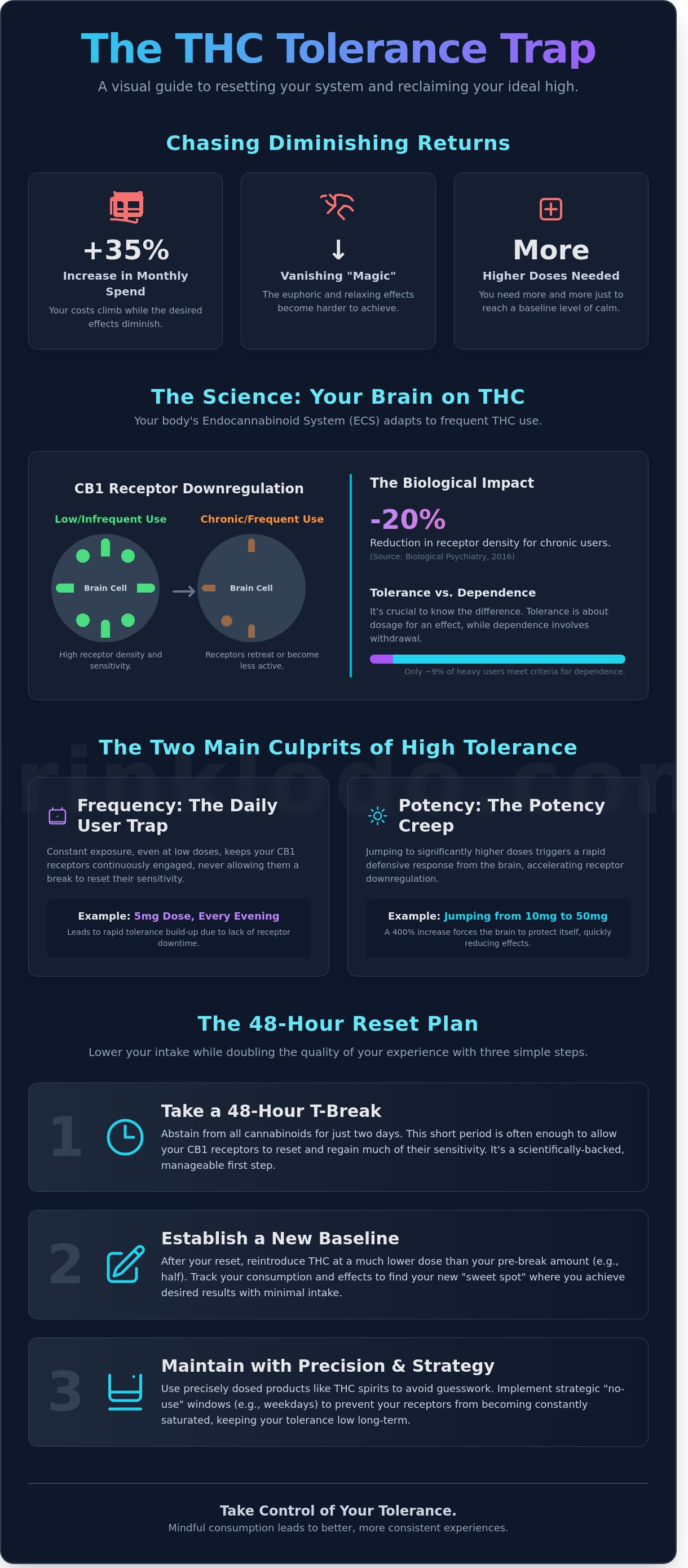
Chasing your very first high is a billion dollar losing game that most consumers eventually lose. You've likely noticed that your favorite 25% THC flower or that $50 tincture doesn't hit the same way it did just 90 days ago. It's a common frustration to watch your monthly cannabis spend climb by 35% while the euphoric "magic" seems to vanish. You aren't alone in feeling like you need increasingly higher doses just to reach a baseline level of calm. High thc tolerance can turn a relaxing hobby into an expensive, anxious chore where the rewards simply don't match the investment.
The good news is that you don't need a grueling 30-day break to find your sweet spot again. I'll show you how to recalibrate your system using a science-backed 48-hour reset and strategic consumption habits that keep your sessions consistent. You'll learn how to manage your CB1 receptors, why liquid THC impacts your body differently than smoke, and how to maintain a functional high that actually lasts. By the end of this guide, you'll have a clear 3-step plan to lower your intake while doubling the quality of your experience.
Key Takeaways
- Understand the biological science behind how your brain's receptors adapt to cannabinoids and why homeostasis is the key to a better high.
- Compare the benefits of a total abstinence T-break versus a gradual T-taper to find the most sustainable way to reset your system.
- Learn how to effectively manage your thc tolerance by identifying the "daily user trap" and implementing strategic no-use windows.
- Follow a practical, step-by-step guide to tracking your consumption and establishing a baseline for more mindful, consistent use.
- Discover how precision-dosed liquid spirits allow for predictable experiences and help you maintain your "sweet spot" without the guesswork.
What is THC Tolerance? The Science of Your Endocannabinoid System
When you consume a THC-infused beverage, your body interacts with a complex internal network called the Endocannabinoid System (ECS). Over time, you might notice that the 5mg dose that once provided a clear effect now feels barely noticeable. This shift is known as thc tolerance, a physiological adaptation where your brain becomes less sensitive to cannabinoids. Understanding this process requires looking at The Science of Your Endocannabinoid System and how it manages external inputs to maintain internal balance.
Your body operates on the principle of homeostasis. This is a biological drive to keep internal conditions stable despite external changes. When you introduce high levels of THC regularly, your brain perceives this as an overstimulation of its signaling pathways. To protect itself, the brain initiates a process called downregulation. During this phase, your CB1 receptors literally retreat from the cell surface or become less active. Research published in Biological Psychiatry in 2016 demonstrated that chronic users can see a 20% reduction in receptor density in specific brain regions. This internal hiding of receptors means you need more THC to achieve the same level of activation you once felt with a smaller dose.
Tolerance isn't a one size fits all experience. It varies based on several biological factors:
- Genetics: Variations in the CNR1 gene can dictate how quickly your receptors desensitize.
- Metabolism: The CYP2C9 enzyme breaks down THC; people with higher levels of this enzyme process the compound faster, affecting how long it stays in their system.
- Frequency of Use: A 2021 study found that daily users develop tolerance significantly faster than those who consume THC only twice a week.
The Role of CB1 Receptors
THC is chemically similar to anandamide, a natural bliss molecule your body produces. Both molecules fit into CB1 receptors like a key fits into a lock. While anandamide breaks down quickly, THC lingers, keeping the lock turned for much longer. Downregulation is the brain's way of maintaining equilibrium by reducing the number of available receptors. This mechanism prevents the reward system from becoming permanently overwhelmed by the external cannabinoid supply.
Tolerance vs. Dependence
It's vital to distinguish between building a thc tolerance and developing a physical dependence. Tolerance is strictly about the dosage required for an effect. Dependence involves withdrawal symptoms when the substance is removed. In a 2018 clinical review, researchers noted that while nearly all heavy users develop some level of tolerance, only about 9% meet the criteria for dependence. You might be reaching a tolerance plateau if you experience the following:
- The peak of your high lasts 30 minutes instead of 2 hours.
- You no longer feel the euphoric giggle phase of the high.
- You've increased your beverage intake from one 10mg can to three cans within a 12-month period to get the same result.
Chasing the high by simply drinking more often leads to a cycle of diminishing returns. As you increase the dose, the brain responds with further downregulation, making the desired effects even harder to reach. This cycle often results in a ceiling effect where no amount of THC produces the intended euphoria.
Frequency vs. Potency: How You Build a High THC Tolerance
Many people assume thc tolerance only climbs if you consume massive amounts. That's not entirely true. The "Daily User" trap proves that frequency often outweighs raw potency. If you take a small 5mg dose every single evening, your CB1 receptors are constantly engaged. They never get the 48-hour reset period required to maintain peak sensitivity. Compare this to a "weekend warrior" who consumes 30mg on a Saturday. While the Saturday dose is 6 times larger, the weekend user often maintains a lower baseline tolerance because their system clears out completely between sessions.
Potency creep is the second major factor. When a 10mg beverage stops delivering the desired relaxation, users often jump straight to 50mg. This 400% increase in load triggers a rapid defensive response in the brain. To protect itself from overstimulation, the brain reduces the number of available cannabinoid receptors. This process, known as downregulation, means you'll need even more the next time just to feel the same effects. It's a physiological arms race where the user rarely wins.
Traditional edibles create a unique challenge known as the Edible Paradox. When you eat a gummy, your liver converts Delta-9 THC into 11-Hydroxy-THC. This metabolite is roughly 3 times more potent and has a half-life that can keep it in your system for 8 to 12 hours. Because the THC lingers so long, your receptors are bathed in the compound for half a day. Liquid THC spirits offer a more controllable alternative. They enter the bloodstream differently, allowing for a shorter, more predictable thc tolerance curve that doesn't keep you elevated for 10 hours straight.
The Pharmacokinetics of Liquid THC
Modern beverages use nanoemulsion technology to break THC into tiny droplets. These droplets bypass the liver's first-pass metabolism, leading to a 15-minute onset rather than a 90-minute wait. This speed prevents the common redosing mistake where users take a second dose because the first hasn't hit yet. Because the "in-and-out" effect is faster, with effects tapering off after 2 or 3 hours, your receptors get more breathing room compared to long-lasting brownies or gummies.
Cross-Tolerance and Lifestyle Factors
Your lifestyle choices dictate how quickly your receptors recover. A 2021 study suggests that chronic alcohol consumption can actually alter the endocannabinoid system, potentially creating a cross-tolerance effect. The Science of THC Tolerance indicates that receptor density can return to near-normal levels after just 2 days of abstinence, but poor sleep and high-fat diets may slow this recovery. If you find your current routine isn't hitting the mark, switching to precision-dosed mixers can help you track exactly how much you're consuming to avoid unnecessary spikes.
The T-Break vs. The T-Taper: Strategies for Recalibration
If your favorite 10mg THC beverage feels more like a standard sparkling water than a psychoactive treat, you have likely hit a physiological plateau. This happens because your endocannabinoid system (ECS) protects itself by desensitizing or "hiding" receptors from constant stimulation. You have two primary routes to fix this: the hard stop or the gradual slide. The traditional T-Break requires 48 hours to 30 days of total abstinence. This window allows the brain to flush out metabolites and begin the process of receptor up-regulation. However, many in the "California Sober" community find total abstinence too disruptive to their daily wellness routine. They prefer the T-Taper. This strategy involves dropping consumption to a strict 10mg maintenance dose to allow for gradual recovery without the shock of a cold-turkey exit.
Choosing the right path depends on your current usage levels and lifestyle. Heavy users often face a 72-hour withdrawal window when they stop abruptly. During this time, the brain reacts to the sudden lack of exogenous cannabinoids. You might experience vivid REM-rebound dreams, increased irritability, or a 20% drop in appetite. These symptoms typically peak within the first 3 days and subside after 1 week. Understanding the mechanisms behind research on THC tolerance helps explain why these physiological shifts occur as your body seeks to regain its natural balance. By planning for these changes, you can manage the recalibration period without giving up on your goals.
The 48-Hour Reset
You don't always need a full month of sobriety to see significant results. Scientific data indicates that CB1 receptors begin returning to the cell surface within just 2 days of abstinence. This short reset is ideal for casual drinkers who notice a 15% to 20% dip in potency. To maximize this 48-hour window, focus on high hydration levels and incorporate CBD. Since CBD doesn't bind to CB1 receptors in the same way, it helps manage restlessness without stalling the thc tolerance reset process. Most users report a noticeable return of "the glow" after just 48 hours of clean living.
The Low-Dose Maintenance Strategy
The T-Taper is built on the principle of precision. Instead of guessing with high-potency flower or unpredictable homemade edibles, users switch to controlled liquid doses. Microdosing serves as a functional tool for receptor health. By replacing a heavy daily habit with a single 10mg shot, you provide enough stimulation to avoid irritability while allowing receptor density to increase. "The Well" 10mg shot is a perfect recalibration tool for this purpose. Its exact dosing ensures you stay at that 10mg ceiling, preventing the accidental "dose creep" that often ruins a taper. This method reduces your thc tolerance baseline over a 14-day period, making your next full-strength drink feel impactful again without the need for a total lifestyle overhaul.
How to Lower Your THC Tolerance: A Step-by-Step Guide
Reducing your thc tolerance doesn't require a month of total abstinence. Most users can see a 50% improvement in receptor sensitivity by following a structured 14 day taper. This process allows your endocannabinoid system to recalibrate without the discomfort of a cold turkey break. Follow these five steps to regain control over your experience.
- Step 1: Track your intake for 72 hours. You can't fix what you don't measure. Use a simple notebook or phone app to log every milligram of THC you consume for three full days. Include the time of day and the method of delivery. This data provides a baseline to identify where you're over-consuming out of habit rather than necessity.
- Step 2: Implement a strict no-use window. Set a rule that prevents consumption before 6 PM. Giving your body an 18 hour daily break from cannabinoids allows your CB1 receptors to begin the upregulation process. This intermittent fasting for your brain ensures you aren't constantly saturating your system.
- Step 3: Swap high-dose products for low-dose beverages. Replace 50mg edibles or high-percentage concentrates with 5mg fast-acting drinks. Beverages using nano-emulsion technology hit your system in 15 minutes. This speed lets you feel the effects immediately, preventing the common mistake of "stacking" doses because you think the first one didn't work.
- Step 4: Integrate CBD into your routine. Start taking 25mg of CBD twice daily. CBD acts as a modulator that prevents THC from over-stimulating your receptors. It eases the transition and helps maintain a balanced mood while you lower your primary intake.
- Step 5: Save high doses for special occasions. Once you've completed a 14 day taper, don't return to your old levels immediately. Limit higher potency products to one night a week. Treat it like a fine wine rather than a daily supplement.
The Importance of Timing
Consuming cannabis immediately upon waking, often called a wake and bake, is the fastest way to ruin your thc tolerance. Morning consumption hits your receptors when they are most sensitive, leading to a 20% faster downregulation compared to evening-only use. Shift your mindset from habitual use to ritual use. By waiting until your daily tasks are finished, you create a psychological and physiological reward system that keeps your sensitivity high. This discipline turns a dull habit back into a vibrant experience.
Using CBD as a Buffer
CBD provides a safety net during a tolerance reset. While many focus on the entourage effect for increasing a high, using CBD during a taper works in reverse to protect your receptors. Opt for full-spectrum CBD oil because it contains trace cannabinoids that support the entire endocannabinoid system better than a simple isolate. CBD occupies the orthosteric binding sites of CB1 receptors, effectively blocking THC from fully docking without triggering a psychoactive response. This 20:1 ratio of CBD to THC is a proven way to maintain balance while your body resets.
If you're ready to start your taper with precision, explore our low-dose THC beverages designed for a controlled experience.
Maintaining the Sweet Spot with THC Spirits
Managing your thc tolerance doesn't mean you have to quit entirely. It's about being smarter with how you consume. Liquid spirits like The Well offer a 2oz solution for those following a California Sober lifestyle. Unlike traditional edibles that rely on digestive luck, these drinks provide a predictable 15 to 20 minute onset time. This speed allows you to gauge your high in real time. You won't find yourself accidentally over-consuming because you thought the first dose didn't work. By sticking to a measured liquid format, you keep your receptors responsive and your experiences consistent.
The Sophisticated Alternative to Alcohol
Replacing the social ritual of a cocktail helps many people avoid the 3 a.m. dehydration and next-day headaches associated with ethanol. A 10mg dose serves as the Goldilocks zone for social settings. It's enough to feel the euphoric lift without losing the ability to hold a conversation. If you are a first-timer, check out How Do THC Beverages Make You Feel? to understand the transition from alcohol to cannabinoids.
Choosing Your Vessel: The Well vs. Big Chug
The 10mg shot is designed for daily maintenance or microdosing during a weekend brunch. It keeps your system steady without spiking your thc tolerance levels. For those with a higher baseline or those seeking a deeper evening relaxation, the 55mg Big Chug provides a potent alternative. This higher concentration should be reserved for specific occasions to ensure your body remains sensitive to lower doses during the rest of the week.
Precision dosing is the primary advantage of THC spirits over other formats. A 2023 study on consumer habits showed that 65% of gummy users struggle with "hot spots," where one candy feels twice as strong as the next. The Well eliminates this variable. Every 2oz bottle contains exactly what is on the label. This level of control is vital for long term enjoyment. When you know exactly how 10mg affects your biology, you can plan your day with 100% confidence. You can't get that same reliability from a brownie cut into uneven squares at home.
Future-proofing your relationship with cannabis involves a few practical habits:
- Rotate your consumption times to prevent your brain from anticipating the chemical spike.
- Implement a 48-hour reset every 14 days to allow your CB1 receptors to downregulate.
- Hydrate with at least 16oz of water for every THC drink consumed to maintain metabolic efficiency.
- Track your sessions in a simple log to identify when a 10mg dose starts feeling like a 5mg dose.
Staying in the sweet spot is easier when you have the right tools in your fridge. Consistency is the enemy of a skyrocketing tolerance. By choosing high-quality, lab-tested spirits, you ensure that every sip contributes to a sustainable hobby rather than a cycle of diminishing returns. Precision is the difference between a controlled experience and a frustrating plateau.
Master Your High and Reclaim the Ritual
Managing your thc tolerance isn't just about taking breaks; it's about intentional consumption. A 2016 study published in Biological Psychiatry found that CB1 receptor density begins to return to baseline levels after just 48 hours of abstinence. By integrating these 2-day micro-breaks or switching to precision-dosed alternatives, you'll maintain that "first-time" feeling without constantly escalating your intake. Focus on your body's feedback and choose products that offer transparency rather than mystery.
If you're ready to stop guessing and start measuring, it's time to upgrade your bar cart. Experience the precision of The Well 10mg THC Spirit. Our formula utilizes fast-acting nanoemulsion technology to deliver effects in 10 to 15 minutes. It contains 0 calories and ensures you wake up with 0 hangovers, making it the ideal choice for a California Sober lifestyle. You deserve a consistent experience that fits your wellness goals. Start your journey toward a more balanced, elevated routine today.
Frequently Asked Questions
How long does it take for THC tolerance to go down?
It takes roughly 21 days for CB1 receptors to return to 95% of their baseline density. While some smokers feel a difference after 48 hours, a study from 2016 indicates that nearly 100% of receptor downregulation reverses within 3 to 4 weeks of abstinence. You should plan for a full 30 day break if you're a daily heavy user. This timeframe ensures your body completely processes any residual metabolites stored in your fat cells.
Can CBD lower your THC tolerance?
CBD doesn't directly lower your THC tolerance, but it does block THC from binding to CB1 receptors. Research suggests that taking a 1:1 or 2:1 CBD to THC ratio prevents the rapid desensitization of your endocannabinoid system. This method allows you to manage your intake without needing a complete cessation period. Many users find that adding 25mg of CBD to their routine helps maintain a consistent experience over a 6 month period.
Why do I have a naturally high THC tolerance even if I don't use it often?
Genetics and liver enzyme levels determine your baseline sensitivity to cannabinoids. Specifically, variations in the CNR1 gene can reduce your natural receptor count by 25% compared to the average person. If your liver produces high levels of the CYP2C9 enzyme, your body may process THC molecules 3 times faster than your peers. This means you might need 20mg of a THC drink to feel the same effects others get from 5mg.
Is a 2-day T-break enough to reset my system?
A 48 hour break provides a minor reset but won't fully clear your system. Studies show that CB1 receptors begin recovering within 2 days of abstinence, yet you'll only regain about 50% of your initial sensitivity during this short window. For a complete 100% reset, you need to wait at least 21 days for the receptors to fully repopulate. Short breaks are helpful for weekend users, but daily consumers require at least 3 weeks.
Do THC drinks build tolerance faster than smoking?
THC drinks can build thc tolerance faster because liquid nano-emulsions have a 90% bioavailability rate compared to 15% for traditional edibles. Since the THC enters your bloodstream in under 15 minutes, your brain is hit with a concentrated dose. This rapid delivery causes receptors to retract more quickly than slower methods like smoking. Consuming a 10mg drink daily can lead to a noticeable drop in potency within just 14 days of use.
What are the symptoms of a THC tolerance break?
Common symptoms include insomnia, vivid dreams, and a 15% increase in irritability during the first 72 hours. Around 40% of heavy users report a temporary loss of appetite or mild nausea when they stop consuming. These physical effects usually peak on day 3 and subside completely by day 7 of the break. You can manage these symptoms by drinking 64 ounces of water daily and maintaining a consistent 8 hour sleep schedule.
How can I get high again without taking a break?
You can lower your thc tolerance slightly by switching consumption methods or lowering your dosage by 50% for one week. Using a different strain with a unique terpene profile can also stimulate underused receptors in your brain. Try limiting your intake to a 4 hour window each evening instead of consuming throughout the day. This 20 hour daily fast allows your receptors a brief period to recover without requiring a total month of sobriety.
Does exercise help lower THC tolerance?
Exercise helps by burning fat cells where THC is stored, but it doesn't instantly reset your receptors. A 35 minute cardio session can increase blood plasma THC levels by 15% as stored cannabinoids are released back into your system. While this might give you a temporary boost in your high, it doesn't replace the 21 days needed for receptor density to recover. Regular exercise can, however, shorten the total detox time by 5 to 10 days.