


Redefining Sobriety: The Ultimate Guide to California Sober in 2026
What if you could enjoy a vibrant social life, feel a pleasant buzz, and still wake up at 7 a.m. on a Saturday feeling completely refreshed? Imagine ending your night out without the looming dread of a next-day headache or a weekend lost to recovery. It’s a frustrating cycle; you want to connect with friends and unwind, but the price of alcohol, from brain fog to anxiety, feels steeper than ever. So many of us are tired of sacrificing our health and productivity for a few hours of fun.
This is where the california sober lifestyle comes in. This guide will show you exactly how to redefine your relationship with socializing by embracing cannabis-infused spirits. You'll discover a mindful, hangover-free alternative that enhances your mood without the negative side effects of alcohol. We’ll explore the best THC beverages on the market for 2026, share tips for dosing and socializing confidently, and break down the science behind why this approach can lead to better sleep and sharper mornings.
Key Takeaways
- Understand the modern definition of the california sober lifestyle and the science behind why it can eliminate hangovers.
- Discover a practical framework for transitioning from alcohol by identifying your triggers and establishing new social rituals.
- Explore how THC spirits are elevating social occasions, offering a sophisticated way to mix cocktails without alcohol.
- Uncover the arguments in the "real sobriety" debate and hear what recovery experts think about this growing trend.
What Does California Sober Mean in 2026?
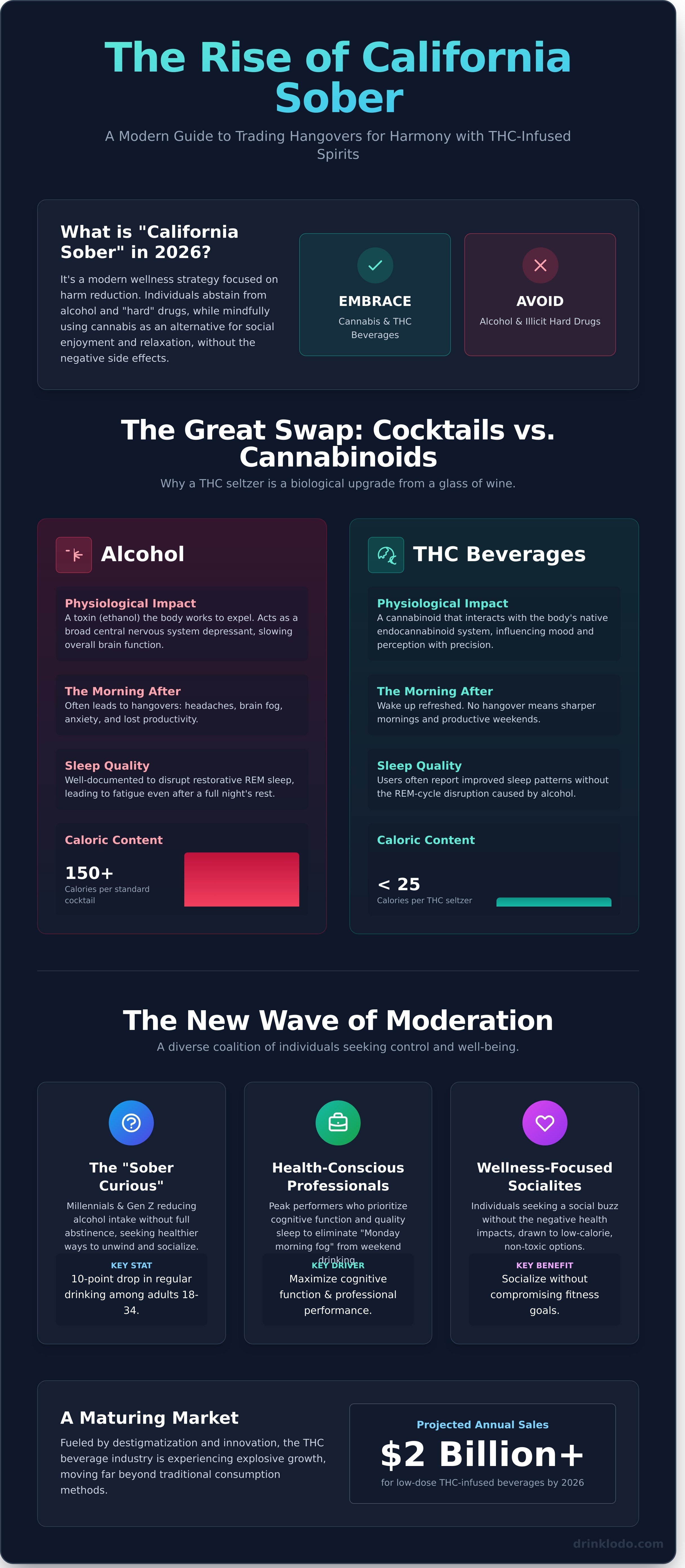
By 2026, the term "California Sober" has firmly shed its controversial origins to become a mainstream wellness strategy. At its core, the definition remains consistent: abstaining from alcohol and illicit "hard" drugs like cocaine, heroin, or methamphetamines, while continuing to use cannabis. What has changed dramatically is the context. This approach is no longer seen merely as a contentious "hack" within recovery circles but as a deliberate lifestyle choice adopted by millions, largely propelled by the "Sober Curious" movement that gained significant momentum in the early 2020s.
This evolution represents a broader cultural shift towards harm reduction as a personal health philosophy. Instead of pursuing an all-or-nothing model of total abstinence, a growing number of adults are choosing a middle path. They are actively reducing or eliminating substances they identify as most harmful to their physical and mental well-being, primarily alcohol, while retaining others they feel offer benefits with fewer downsides. The california sober lifestyle of 2026 is less about addiction recovery and more about optimizing daily performance, mental clarity, and social enjoyment.
The Origins vs. Modern Reality
Tracing the term's journey reveals a rapid evolution from niche slang to a globally recognized concept. While its precise beginnings are debated, understanding the basic answer to "What is California Sober?" means acknowledging its shift from an underground idea to a public wellness trend. This change was accelerated by a revolution in cannabis perception, bolstered by the August 2023 recommendation from the U.S. Department of Health and Human Services to reclassify cannabis to a less restrictive category. This move signaled a major federal shift, destigmatizing its use. Consequently, the market has matured far beyond smoking flower. By 2026, the industry is dominated by sophisticated, low-dose THC-infused seltzers and beverages, a market segment projected to exceed $2 billion in annual sales.
Who is the Cali Sober Lifestyle For?
The modern adopter of this lifestyle isn't a single demographic but a diverse coalition of individuals seeking moderation and control. They typically fall into one of three primary groups:
- The "Sober Curious": This group, largely composed of Millennials and Gen Z, seeks to decrease alcohol consumption without committing to complete teetotalism. A 2023 Gallup poll confirmed this trend, showing a 10-point drop in regular drinking among adults aged 18-34 compared to two decades prior. For them, cannabis offers a way to unwind without the negative effects of alcohol.
- Health-Conscious Professionals: These are individuals focused on peak performance who want to eliminate the "Monday morning fog" caused by weekend drinking. They prioritize sleep quality and cognitive function, trading alcohol's well-documented disruption of REM sleep for a cannabis alternative they find less impairing to their professional lives.
- Wellness-Focused Socialites: This cohort seeks a social buzz without the negative health impacts of ethanol. They are drawn to the low-calorie nature of THC beverages, which often contain fewer than 25 calories per can compared to the 150+ calories in a standard cocktail. It's a choice driven by a desire to socialize without compromising fitness goals or consuming a known toxin.
The Science of Swapping: Why People are Trading Cocktails for Cannabinoids
The cultural shift towards mindful consumption isn't just a trend; it's a decision rooted in biology. When you choose a THC-infused seltzer over a glass of wine, you're opting for an entirely different physiological process. Understanding this science is key to grasping why the california sober lifestyle is gaining such rapid momentum. It's not about replacing one buzz with another. It’s about upgrading the experience entirely.
At its core, the swap is a move from a toxin to a cannabinoid. Alcohol (ethanol) is a poison that the body works hard to metabolize and expel. THC, on the other hand, interacts with a system already built into our bodies: the endocannabinoid system. This fundamental difference explains nearly every advantage, from the morning after to the long-term health benefits.
Alcohol vs. THC: A Neurological Perspective
Ethanol acts as a broad central nervous system depressant. It enhances the effects of GABA, the brain's primary inhibitory neurotransmitter, which slows down brain function, impairs judgment, and degrades motor control. THC operates on a more specialized network. It primarily binds to CB1 receptors in the endocannabinoid system, influencing mood and perception without the same widespread neurological shutdown. This is why a low dose of THC can foster relaxation and social ease without the slurred speech or stumbling that often accompanies a few alcoholic drinks. Nanoemulsion is the groundbreaking technology that allows water-soluble THC to be absorbed rapidly, often within 10-15 minutes, mirroring the social ritual of sipping a cocktail.
The Health Benefits of the Switch
The long-term health implications of this swap are significant. The CDC reports that excessive alcohol use leads to approximately 178,000 deaths in the U.S. each year, with liver disease being a primary contributor. By removing ethanol, you eliminate a direct assault on your liver and reduce systemic inflammation.
The benefits extend to your waistline, too. Consider the calories:
- Standard 5 oz. Glass of Wine: 123 calories, 3.8g carbs
- Standard 12 oz. Beer: 153 calories, 12.6g carbs
- Typical 2.5mg THC Seltzer: 5-25 calories, 0-2g carbs
This stark contrast makes THC spirits the clear diet-friendly choice for 2026 and beyond, removing hundreds of "empty" sugar calories from a typical night out.
Perhaps the most immediate benefit is the impact on mental clarity. Alcohol is notorious for disrupting REM sleep, the restorative stage crucial for memory and mood regulation. This disruption is a major cause of "hangxiety," the feeling of heightened anxiety and dread the day after drinking. While the cannabis-and-sleep relationship is complex, low-dose THC doesn't cause the same sharp, anxiety-inducing rebound. This harm-reduction approach is a central pillar in The Debate Over California Sober, which evaluates substituting substances to mitigate negative health outcomes. By choosing a path that supports better sleep and a clearer mind, individuals embracing the california sober movement are investing in their mental well-being. For those looking to make a mindful change, it's worth it to explore expertly crafted THC beverages that deliver a clean social buzz.
The Great Debate: Is California Sobriety "Real" Sobriety?
The central conflict surrounding the california sober lifestyle boils down to a single, pointed question: Is it genuine recovery or just trading one vice for another? This isn't a simple yes-or-no answer. The truth is complex, shaped by medical science, cultural shifts, and intensely personal definitions of what it means to be well.
For many, the idea of using any mind-altering substance feels like a contradiction to sobriety. Critics argue that true recovery requires complete abstinence. Yet, proponents see it as a pragmatic and sustainable form of harm reduction. This isn't just a philosophical disagreement; it's a debate that pits traditional recovery models against a modern, individualized approach to health. Understanding both sides is the key to deciding if this path is right for you.
Addiction Specialists vs. Lifestyle Advocates
Traditional addiction medicine often draws a hard line. Institutions like the Cleveland Clinic explicitly warn that for individuals with a diagnosed Substance Use Disorder (SUD), replacing alcohol with cannabis can be a "slippery slope" that risks relapse. The Substance Abuse and Mental Health Services Administration (SAMHSA) consistently promotes abstinence-based recovery, as its 2022 National Survey on Drug Use and Health identified over 48.7 million people with SUD who may require structured support. These warnings are critical for those with a history of severe addiction.
On the other side, lifestyle advocates argue for what could be called "functional sobriety." In a high-stress world, they see mindful cannabis use as a tool for managing anxiety or pain without the destructive consequences of alcohol. By 2026, the cultural conversation has shifted heavily toward "Mindful Consumption," prioritizing intentionality over the rigid, all-or-nothing labels of the past.
Navigating the "Gateway Drug" Misconception
The "gateway drug" theory, which posits that cannabis use inevitably leads to harder substances, has been largely challenged by modern data. The National Institute on Drug Abuse (NIDA) confirms that the vast majority of people who use cannabis do not go on to use other, "harder" substances. The focus for many has now shifted to the "exit drug" concept, where cannabis is used to wean off more dangerous substances.
A 2019 study in the Harm Reduction Journal found that 40% of its 2,102 medical cannabis patient participants used it as a substitute for alcohol, and 76.7% used it to replace opioids. This reframes cannabis not as a starting point for addiction, but as a potential off-ramp. However, personal honesty is non-negotiable. It's vital to set firm boundaries and watch for red flags in your own use.
- Frequency Creep: Is your "occasional" use becoming a daily, non-negotiable ritual?
- Dependency: Do you feel you need it to cope with normal stress or to feel creative?
- Neglecting Responsibilities: Is your use interfering with your work, relationships, or health goals?
Ultimately, the effectiveness of the california sober approach hinges on radical self-awareness. It demands that you define what sobriety and health mean for your unique journey, using cannabis as a deliberate tool rather than an unconscious crutch.
How to Transition to a Cali Sober Lifestyle Successfully
Adopting a new lifestyle isn't about flipping a switch; it's about building a sustainable system. Transitioning to a california sober approach requires intention, especially when alcohol has been a long-standing part of your social or relaxation rituals. Success comes from understanding your own habits and replacing them with mindful, healthier alternatives. It starts with a simple audit and ends with a more balanced you.
Think of the first 30 days as a data-gathering mission. Your goal is to learn how your body and mind respond to this change. Forget perfection. Focus on observation.
Audit Your "Why"
Before you can change a habit, you must understand its roots. For one week, keep a simple log. Every time you feel the urge to drink alcohol, note the trigger. Was it a stressful email at 4:45 PM? Was it social awkwardness walking into a party? Or was it simply the ritual of opening a bottle while making dinner? Identifying these specific moments is the critical first step. You aren't judging yourself; you're just collecting data to create a better strategy.
Find Your New Ritual
Much of drinking's appeal is the ceremony. The sound of a can cracking open, the clink of ice in a glass, the pop of a cork. Don't discard the ritual; reinvent it. Replace the beer or wine with a precisely dosed THC beverage. Take the time to pour it into a nice glass, add a garnish like a lime wedge or a sprig of mint, and savor it. This act of replacement satisfies the brain's craving for a familiar routine, making the absence of alcohol feel less like a void and more like an intentional upgrade.
Master the Dosage: Start Low and Slow
The golden rule for anyone new to cannabis beverages is to start with a low dose and go slow. Unlike alcohol, the effects of THC are not always linear. Your "sweet spot" is the minimum dose required to achieve the desired effect, whether that's gentle relaxation or a light social buzz. For most people, this is between 2.5mg and 5mg of THC.
- Track Everything: Note the dosage, the time you consumed it, and how you felt 30 and 60 minutes later.
- Wait It Out: Give a single dose at least 90 minutes to take full effect before even considering a second.
- Context Matters: Your tolerance can be affected by factors like food intake and fatigue. A 5mg dose on an empty stomach will feel different than after a full meal.
Ready to find your perfect ritual? Explore our range of precisely dosed THC spirits to start your journey.
The Social Playbook
Navigating social settings is often the biggest hurdle. Prepare a few simple, non-confrontational responses for when someone asks why you aren't drinking. A calm "I'm taking a break for a while" or "I'm trying something different tonight" usually suffices. The growing "Bring Your Own THC" (BYO-THC) trend at parties normalizes bringing a 4-pack of cannabis seltzers just as you would a bottle of wine, a shift reflecting a broader cultural acceptance.
Dosage and Timing for Beginners
Think of 5-10mg of THC as the rough equivalent of one "standard drink" like a 12 oz beer. Pacing is key; you can always have more, but you can't have less. A beginner should "sip" a 5mg drink over 30-45 minutes, not take it like a "shot." Liquid THC beverages often have a faster onset, typically 15-30 minutes, compared to the 60-90 minutes for traditional edibles like gummies, because cannabinoids are absorbed directly through the mucous membranes in your mouth and under your tongue.
Track Your Progress
During your first 30 days of a cali sober lifestyle, monitor key biometrics. Use a journal or a simple notes app to record your daily:
- Sleep Quality: Did you wake up rested? Data from wearables like the Oura Ring shows many users experience a 10-15% increase in REM and deep sleep after cutting out alcohol.
- Energy Levels: Rate your morning energy on a scale of 1 to 10.
- Mood: Note overall mood and any instances of anxiety or irritability.
Elevating the Experience: THC Spirits as the New Social Standard
The california sober lifestyle isn't just about what you avoid; it's about what you embrace. For too long, the choice has been between a traditional alcoholic cocktail and a lackluster club soda with lime. That era is over. The social ritual of crafting and sipping a drink deserves a better, more intentional alternative. This is where the next evolution of cannabis consumption shines, moving beyond gummies and pre-mixed seltzers into a more refined format.
We designed The Well as the definitive answer for the sophisticated socialite. It’s a crystal-clear, flavor-neutral THC spirit containing 10mg of fast-acting hemp-derived Delta-9 THC per 1.5-ounce serving. Think of it as the perfect 1:1 replacement for vodka or gin in your favorite cocktails. Unlike a sugary, single-flavor canned beverage, a spirit format puts you in control. It invites creativity and preserves the cherished ritual of mixology. You can build your drink, tailor it to your palate, and enjoy the process, not just the outcome.
Of course, social energy isn't the only goal. Sometimes, the aim is profound relaxation. For those moments, we created The Big Chug. It’s a potent, 55mg THC beverage designed for a higher-octane experience. It’s the perfect nightcap for unwinding after a long week or for seasoned consumers seeking a more significant effect. Having both options means you can precisely calibrate your experience, from a light buzz to deep calm.
This dedication to quality and choice is how Lodo is leading the industry toward a new standard. Market analysts project that by 2026, the hemp beverage sector will be dominated by brands that prioritize verifiable transparency and premium ingredients. We aren't waiting for that shift. We are creating it.
The Ritual of the THC Spirit
Embracing The Well is simple. Pour a 1.5 oz shot over ice, top with your favorite tonic, and add a squeeze of lime for a perfect THC-tonic. Or, for a faster, more communal experience, pour a round of shots. It’s a quick and effective way to set the mood for the evening. The rapid onset means you’ll feel the effects in as little as 15-20 minutes. Explore our 12-pack of THC shots for your next gathering and make it a night to remember.
Quality and Safety You Can Trust
In an evolving market, trust is everything. That’s why every bottle of Lodo features a QR code linking directly to its third-party Certificate of Analysis (COA). This report confirms its potency and purity, ensuring it’s free from pesticides and heavy metals. Because our THC is derived from hemp and complies with the 2018 Farm Bill (containing less than 0.3% Delta-9 THC by dry weight), we can legally ship our products to most states nationwide. This commitment to quality is what the modern california sober consumer demands. Ready to redefine your night? Try The Well THC Spirit today.
Your California Sober Journey Starts Now
The landscape of social drinking is changing for good. As we've explored, the california sober lifestyle in 2026 is about intentional choices, not deprivation. It's a movement centered on ditching the hangovers and empty calories that come with alcohol. You're choosing a clearer, more present way to connect and unwind, and that's a powerful shift in personal wellness.
Ready to redefine your relationship with drinking? You don't have to sacrifice the ritual of crafting a cocktail. Start your alcohol-free journey with The Well THC Spirit. It’s a true game-changer, crafted with nano-emulsified technology for a 15-minute onset, so you can feel the effects as quickly as your first beer. With zero sugar, zero calories, and zero hangovers, it’s the upgrade your social life deserves. Plus, with nationwide shipping on all our hemp-derived THC spirits, a better buzz is just a click away.
Your path is your own. Take the first step toward a more mindful and vibrant social experience today.
Frequently Asked Questions
Is California Sober actually considered being sober?
No, California Sober is not considered true sobriety by traditional recovery standards. Programs like Alcoholics Anonymous define sobriety as complete abstinence from all mind-altering substances, including cannabis. This lifestyle is better understood as a form of harm reduction, where individuals eliminate alcohol and other specific drugs but continue to use substances like marijuana. It prioritizes reducing negative consequences over total abstinence.
Can I still get a hangover from THC drinks?
Yes, you can experience a "weed hangover" after consuming THC drinks, especially in high doses. While it's different from an alcohol-induced hangover, symptoms can include brain fog, fatigue, headaches, and dry mouth. This is more common if you consume over 10mg of THC in a session or are new to edibles. The effects can linger because the body metabolizes edible THC much more slowly than inhaled THC.
How much THC is equal to one alcoholic drink?
There isn't a direct scientific conversion between THC and alcohol because they affect the body through completely different mechanisms. A standard alcoholic drink has 14 grams of pure alcohol, while a common dose in a THC beverage is 2-5mg. Their effects vary wildly based on your personal tolerance, metabolism, and body chemistry. It’s best to start with a low dose of 2.5mg of THC and wait at least an hour before consuming more.
Will California Sobriety help with my anxiety?
It might, but it could also make it worse. While a 2018 study in the *Journal of Affective Disorders* found that cannabis can temporarily reduce stress, long-term use can sometimes increase anxiety or lead to dependence. The outcome often depends on the dosage and the ratio of THC to CBD. It's critical to consult a healthcare professional before using cannabis to self-medicate a mental health condition like anxiety.
Is it safe to drive if I am California Sober?
No, it is never safe or legal to drive under the influence of cannabis. Driving while impaired by THC is illegal in all 50 states and significantly increases your risk of an accident. The National Highway Traffic Safety Administration (NHTSA) reports that marijuana use can slow reaction time and impair cognitive performance. You should wait at least 4-6 hours after consuming a standard THC edible or drink before driving.
Can I do California Sober if I have a history of addiction?
This approach should be considered very carefully and discussed with an addiction specialist. Some harm reduction advocates view it as a pragmatic step away from more destructive substances like alcohol or opioids. However, many addiction experts, including those aligned with SAMHSA, warn that substituting one substance for another fails to address the underlying issues of addiction and can create a new dependency.
What are the best drinks for someone who is California Sober?
The best options are typically low-dose, cannabis-infused beverages that allow for controlled consumption. Look for THC seltzers or tonics that clearly state a dosage of 2-5mg of THC per serving, which creates a mild, sociable buzz. Brands like Cann and Artet are popular choices. For social situations without any substances, high-quality non-alcoholic beers, kombucha, or artisanal mocktails are excellent alternatives for anyone practicing the California sober lifestyle.
Does California Sober include using psychedelics like mushrooms?
Yes, the most common definition of California sober includes the use of psychedelics like psilocybin mushrooms. The term gained significant popularity in 2021 after singer Demi Lovato described their version of the lifestyle as abstaining from alcohol and hard drugs while using marijuana and psychedelics in moderation. However, the definition is flexible, and some people use the term to refer only to cannabis use in place of alcohol.