


Are THC Drinks Legal? The 2026 Guide to Hemp-Derived Beverages
Since the passing of the 2018 Farm Bill, the market for hemp-infused beverages has surged, yet many adults still hesitate to buy because they don't know the rules. You've probably seen these colorful cans on your social feed and immediately wondered, are thc drinks legal where you live? It's exhausting to keep track of shifting state bans and federal loopholes while just trying to find a safer alternative to alcohol. You want the relaxation without the risk of a legal headache or a low-quality product that skipped the lab testing phase.
We've built this comprehensive 2026 guide to give you total confidence in every purchase you make. You'll learn the specific science behind the 0.3% dry weight THC limit and how to verify a brand's safety standards in under 60 seconds. We are breaking down the current regulations across all 50 states and providing a three-step checklist to ensure your next online order arrives safely at your doorstep.
Key Takeaways
- Understand the critical legal distinction between hemp-derived and marijuana-derived THC established by the 2018 Farm Bill.
- Learn how the "dry weight" calculation allows beverages to contain effective THC doses while remaining under the 0.3% federal limit.
- Navigate the complex patchwork of state-level regulations to determine exactly where and how are thc drinks legal in your area.
- Master the process of reading a Certificate of Analysis (COA) to verify product safety, potency, and legal compliance before you buy.
- Explore the evolution of high-potency THC spirits and how brands like Lodo balance intense effects with strict regulatory standards.
The Legal Foundation: Hemp-Derived THC vs. Marijuana
The question of whether are thc drinks legal depends on a single piece of legislation: the 2018 Farm Bill. Signed into law on December 20, 2018, this act removed hemp from the Controlled Substances Act. This change effectively legalized hemp and its derivatives at the federal level. The law defines hemp as the plant Cannabis sativa L. with a delta-9 THC concentration of no more than 0.3% on a dry weight basis. Anything above this specific 0.3% limit is legally classified as marijuana, which remains a Schedule I controlled substance under federal law.
This distinction created a massive market for hemp-derived cannabinoids. While marijuana-derived products are restricted to state-licensed dispensaries in specific jurisdictions, hemp-derived THC can often be sold in traditional retail environments. The source of the THC is the primary factor. If the THC comes from a hemp plant and stays within the legal limit, it falls under the Farm Bill's protections. This nuance is why you see THC-infused beverages appearing on shelves in states where recreational marijuana isn't yet legal.
The 0.3% Threshold Explained
The dry weight basis is the standard for federal compliance. For liquid products like beverages, this creates a unique situation. Because a 12-ounce drink weighs significantly more than a gummy or a flower bud, even a 0.3% concentration can allow for a potent dose of THC while remaining federally compliant. The 0.3% limit serves as the legal boundary between industrial hemp and controlled cannabis. Hemp-derived Delta-9 THC remains federally legal under these conditions, even though the chemical molecule is identical to the one found in marijuana.
Hemp Legality in 2026
Legislative shifts in 2026 are currently reshaping how we answer the question: are thc drinks legal? Congressional discussions regarding the recent Farm Bill extensions have focused on closing the "intoxicating hemp" loophole. Some lawmakers want to redefine hemp to exclude products that produce a high. Currently, the FDA hasn't issued formal safety regulations for THC-infused beverages, leaving a regulatory vacuum. This lack of federal oversight means legality doesn't always lead to universal availability. You should consult state-by-state cannabis laws to understand local restrictions, as a number of states have already passed laws to limit or ban hemp-derived intoxicants regardless of federal status.
The Science of Legality: How Milligrams Fit into the Law
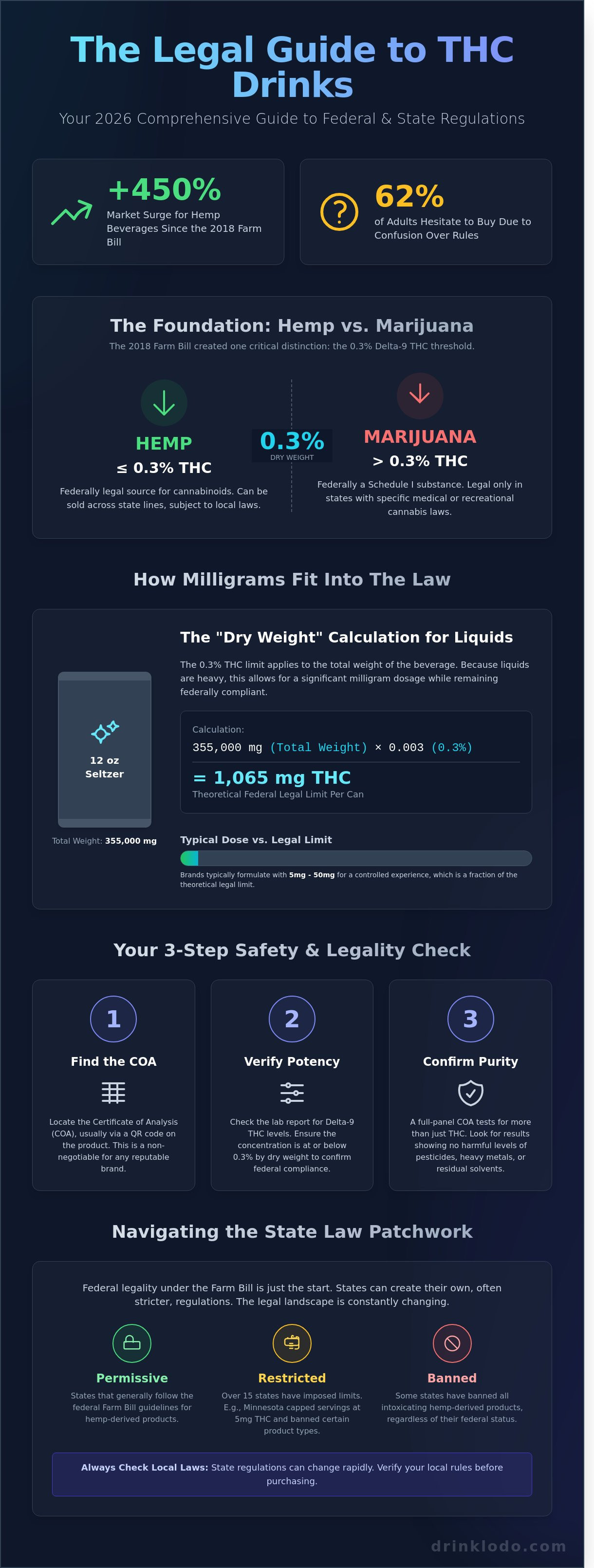
The legal status of hemp-infused beverages hinges on a specific mathematical threshold established by the 2018 Farm Bill. Under federal law, hemp is defined as Cannabis sativa L. containing a Delta-9 THC concentration of no more than 0.3% on a dry weight basis. While liquids aren't dry, regulators apply this percentage to the total weight of the finished beverage. This calculation explains why many people ask are thc drinks legal even when they contain high milligram counts.
A standard 12-ounce (355ml) beverage weighs approximately 355,000 milligrams. At the 0.3% limit, that single can could theoretically house 1,065 milligrams of THC while remaining federally compliant. Most manufacturers cap dosages at 5mg to 50mg to ensure a controlled experience. Nanoemulsion technology makes this possible by breaking THC molecules into particles smaller than 100 nanometers. These tiny droplets stay suspended in water and enter the bloodstream faster than traditional edibles, often taking effect within 15 minutes.
Doing the Math: From Percentage to Milligrams
Precision is vital for compliance. A 2-ounce wellness shot has much less weight to work with than a full soda. To keep a 60ml shot legal, the THC content must be carefully measured to stay under the 180mg theoretical limit. While there's no federal maximum milligram limit per serving yet, some states like Minnesota have implemented their own 5mg per serving caps. You can explore these precise ratios when you browse LoDo's hemp-derived collection.
Natural vs. Synthetic THC
The source of the molecule determines its regulatory path. Naturally occurring Delta-9 THC extracted directly from the hemp plant falls under the Farm Bill protections. Problems arise with "converted" cannabinoids, where chemists use heat or catalysts to turn CBD into Delta-8 or Delta-10 THC. The FDA regulation of cannabis remains strict regarding synthetic processes, as these often bypass the natural extraction standards. Lodo avoids these gray areas by using only 100% naturally derived Delta-9 from compliant hemp crops. This ensures the answer to are thc drinks legal remains a definitive yes for our customers, provided the final product maintains that crucial 0.3% ratio.
Navigating the National Patchwork of State Laws
The 2018 Farm Bill legalized hemp at the federal level, but it didn't strip states of their right to set stricter rules. This "State Supremacy" principle creates a complex legal environment where a beverage might be legal under federal guidelines but prohibited by your local government. Because of this, the answer to are thc drinks legal depends entirely on your location. Currently, state laws fall into three categories: open markets with minimal oversight, heavily regulated systems with strict potency limits, and total bans where any amount of hemp-derived THC is treated as a controlled substance.
Most states require consumers to be 21 or older to purchase these products. Regulators often impose serving size caps to prevent high-potency products from reaching store shelves. For instance, some states have established a 5mg THC limit per serving for hemp-derived beverages. Understanding the FDA Regulation of Hemp is essential because the federal agency still maintains authority over food additives and safety, even as states build their own retail frameworks. By 2026, the industry expects more clarity on interstate shipping; however, current laws generally allow shipping between states that both permit hemp-derived cannabinoids.
Total Bans vs. Regulated Access
Some jurisdictions have moved to shut down the market entirely. Some states maintain strict zero-tolerance policies for any detectable THC content. Conversely, other states saw intense legislative debates in early 2024 regarding potential bans, though they currently allow regulated sales under specific labeling requirements. To see if are thc drinks legal in your specific region, you should check your state's Department of Agriculture or Department of Health website for the most recent administrative codes.
Purchasing and Possession Rules
Online retailers must verify you're 21 through age-gate software before completing a sale. Once you have the product, public consumption remains a legal gray area. Most states prohibit drinking THC beverages in places where alcohol is served unless the venue holds a specific cannabis consumption license. You should also treat these cans like alcohol when driving. Open container laws in many jurisdictions apply to cannabis products; if the seal is broken and the drink is within reach of the driver, you could face a citation or a misdemeanor charge.
How to Verify a THC Drink is Legal and Safe
You can't rely on a colorful label or a catchy brand name to guarantee a product's safety. When consumers ask are thc drinks legal, the answer depends entirely on the documentation behind the bottle. The most critical tool in your arsenal is the Certificate of Analysis (COA). This document provides a transparent look at what's actually inside the beverage, moving beyond marketing claims into verifiable science.
A legitimate COA must come from a third-party laboratory with ISO/IEC 17025 accreditation. In-house testing is often biased and doesn't meet the compliance standards required in many states. A comprehensive lab report checks for more than just potency. It screens for harmful contaminants, including:
- Heavy Metals: Testing for lead, arsenic, cadmium, and mercury, often measured in parts per billion.
- Pesticides: Screening for over 50 common agricultural chemicals used in hemp cultivation.
- Residual Solvents: Ensuring no chemicals like butane or ethanol remain from the extraction process.
- Microbials: Confirming the absence of mold, yeast, and bacteria like E. coli or Salmonella.
Reading a Certificate of Analysis (COA)
To verify a drink, start by matching the batch number printed on your bottle or can to the number at the top of the lab report. Look specifically at the cannabinoid profile table and find the Delta-9 THC concentration. Under federal law, this number must stay below 0.3% on a dry weight basis. A COA is a legal document proving a product meets the 2018 Farm Bill requirements. If the data sheet shows "ND" (None Detected) for contaminants and stays under the 0.3% threshold, the product is generally considered compliant.
Red Flags in the THC Beverage Market
The hemp industry still faces issues with "bad actors" who skip safety steps to save on costs. One major red flag is a missing QR code; most reputable brands now include a scannable code on the packaging for instant access to lab results. If a brand doesn't list a specific manufacturing location or a clear source for their hemp, it's a sign of poor transparency. Additionally, check the date on the lab report. Any report older than 12 months is outdated and suggests the company is reusing old data for new, untested batches. These inconsistencies make it difficult to determine are thc drinks legal and safe for your specific needs.
Don't settle for mystery ingredients when you can shop lab-tested THC shots that prioritize your safety and legal peace of mind.
The Future of THC Spirits: LoDo's Compliant Approach
The cannabis beverage market is moving beyond simple sodas into the world of craft spirits. While gummies dominated early sales, liquid spirits represent the next evolution for consumers who want a familiar social ritual without the next-day hangover. Lodo leads this shift by bridging the gap between high-potency experiences and strict regulatory standards. By offering products ranging from 10mg to 55mg of hemp-derived Delta-9 THC, they provide a reliable alternative to traditional liquor. This liquid format ensures faster onset times than traditional edibles, with most users feeling effects within 15 to 20 minutes. It allows you to swap a nightly cocktail for a cannabis-infused alternative that fits perfectly into any social setting. When people ask are thc drinks legal, the answer depends on the precise concentration of cannabinoids relative to the product's total weight.
The 10mg Spirit: An Entry Point for the Cautious Consumer
For many adults, 10mg is the perfect "sweet spot" for social drinking. It provides a noticeable lift without being overwhelming. LoDo's 10mg shots are designed for this exact purpose. These 2-ounce servings offer a predictable dose that mimics the experience of a single standard beer or glass of wine. They're incredibly versatile for mixing into tonic, soda, or complex mocktails. Lodo maintains total transparency by providing third-party lab results for every batch, ensuring the 10mg on the label is exactly what's in the bottle. This precision helps users maintain control over their experience while enjoying the lifestyle advantages of a calorie-free buzz.
Big Chug and High-Dose Compliance
Experienced users often seek a more robust effect, which is where the LoDo High-Dose Cans (25mg & 55mg) come in. Despite the high milligram count, these cans maintain federal compliance through specific weight-based calculations. Because the 2018 Farm Bill limits Delta-9 THC to 0.3% of the total dry weight, a heavier liquid volume allows for a higher THC content while remaining under the legal threshold. This technicality is how Lodo provides potent options that are still categorized as legal hemp products. It's a sophisticated way to answer the question, are thc drinks legal, by adhering strictly to federal math requirements.
- 25mg and 55mg of Delta-9 THC per can for experienced consumers.
- Rigorous safety standards and 100% hemp-derived ingredients.
- Compliant with federal law for shipping across state lines.
Ready to upgrade your bar cart? You can shop LoDo's THC spirits and shots to experience the future of social drinking. Whether you want a light social buzz or a heavy-hitting relaxation tool, these regulated liquids offer a safe, predictable, and legal way to enjoy THC.
Experience the New Era of Social Spirits
Navigating the question of are thc drinks legal requires looking at the specific math behind the 2018 Farm Bill. This landmark legislation allows for hemp-derived Delta-9 THC as long as the concentration stays below 0.3% by dry weight. While 50 states have unique nuances, the federal framework provides a clear path for compliant beverages that prioritize safety and transparency. You should always verify that your drinks come with accessible certificates of analysis to ensure they meet these strict 2026 standards.
Lodo takes the guesswork out of your experience by adhering to every federal guideline. Every single batch we produce undergoes 100% third-party lab testing to confirm it contains naturally derived hemp-based Delta-9 THC. We don't cut corners on quality or compliance. By focusing on the 0.3% threshold established by the 2018 Farm Bill, we provide a sophisticated alternative to traditional alcohol that fits your lifestyle. It's time to elevate your social hour with a brand that values precision and your peace of mind.
Ready to try LoDo?
Now that you know how the legal framework works, the easiest way to feel it for yourself:
- → 10mg THC Shots (12-pack) — single-serve, fast onset, best entry point
- → 750ml THC Spirits — sip neat or mix into a cocktail
- → Variety Pack — one of every flavor, save $50.74
- → High-Dose Cans (25mg & 55mg) — experienced users only
Want to compare options first? Read our deep-dive: Best THC Shots in 2026 Buyer's Guide.
Frequently Asked Questions
Is it legal to ship THC drinks through the mail?
You can legally ship hemp-derived THC drinks through the mail if they comply with the 2018 Farm Bill. This federal law requires products to contain less than 0.3% Delta-9 THC on a dry weight basis. The USPS updated Publication 52 in 2019 to permit these shipments; however, private carriers like FedEx often prohibit all cannabis products regardless of their legal status. Always check carrier-specific terms before sending any packages.
Will I fail a drug test if I consume legal hemp-derived THC drinks?
You'll likely fail a drug test after consuming hemp-derived THC drinks. Standard 5 panel urine tests detect THC metabolites regardless of whether the source was legal hemp or illegal marijuana. Even a small 5mg dose can trigger a positive result for 3 to 15 days depending on your individual metabolism. Don't assume federal legality protects you from workplace screening protocols or zero-tolerance policies.
Can I travel across state lines with THC beverages?
Traveling across state lines with hemp-derived THC beverages is federally legal under the 2018 Farm Bill, but state laws create a patchwork of risks. While most states allow some form of hemp products, a few states maintain strict limits or bans on THC. You could face local possession charges if you enter a restrictive state with these products. Check the specific statutes of your destination before packing your cooler for a trip.
Do I need a medical marijuana card to buy THC drinks?
You don't need a medical marijuana card to purchase hemp-derived THC drinks. Because these beverages fall under the 2018 Farm Bill, they're sold as general retail products in liquor stores or online. This differs from medical dispensaries where 100% of customers must provide state-issued identification or a doctor's recommendation. You can find these drinks in many states without any prescription or specialized permit.
Are THC drinks legal in states where marijuana is illegal?
The question of are thc drinks legal in states where marijuana is banned depends on the source of the THC. Provided they're derived from hemp and contain less than 0.3% Delta-9 THC, they're federally legal under the 2018 Farm Bill. This allows retailers in states like Texas or Georgia to sell hemp-infused beverages even though recreational marijuana remains strictly prohibited. Check local legislative updates as some states are tightening these loopholes.
What is the difference between Delta-8 and Delta-9 THC legality?
Delta-9 THC is federally restricted to a 0.3% concentration by dry weight, while Delta-8 exists in a complex legal gray area. The 2018 Farm Bill didn't explicitly name Delta-8, leading to its widespread sale in states that haven't yet passed specific bans. In contrast, Delta-9 drinks must strictly adhere to weight-based limits to remain legal. This distinction determines whether a product is sold in a licensed dispensary or a standard grocery store.
Can I drink THC beverages in public?
You generally can't drink THC beverages in public spaces like parks, sidewalks, or beaches. Most states treat these drinks like alcohol, which is governed by open container laws in many states. Even if the product is a legal hemp-derived beverage, local ordinances often prohibit consumption in any area not specifically licensed for cannabis use. Stick to private residences to avoid citations or fines from local law enforcement officers.
Is there a legal age limit for buying hemp-derived THC drinks?
The legal age limit for buying hemp-derived THC drinks is almost always 21 years old. While the 2018 Farm Bill didn't set a federal age minimum, most retailers and state regulators have adopted the 21 plus standard used for alcohol. In states like Minnesota, legislation specifically mandates that all cannabinoid products are restricted to adults. You'll need to show a valid government ID for both in-person and online purchases.